
In Cairo, Algiers and Tunis last month, I asked rooms full of founders the same two questions.
Hands up if you've heard of product market fit.
Every hand went up.
Hands up if you've heard of business model fit.
About half of them came down.
I'm sure I'll get the same response in Accra and Lagos next week, and Johannesburg the week after.
And in every room I said something that surprised a few people. This is my personal opinion, but I hate product market fit. I really hate it.
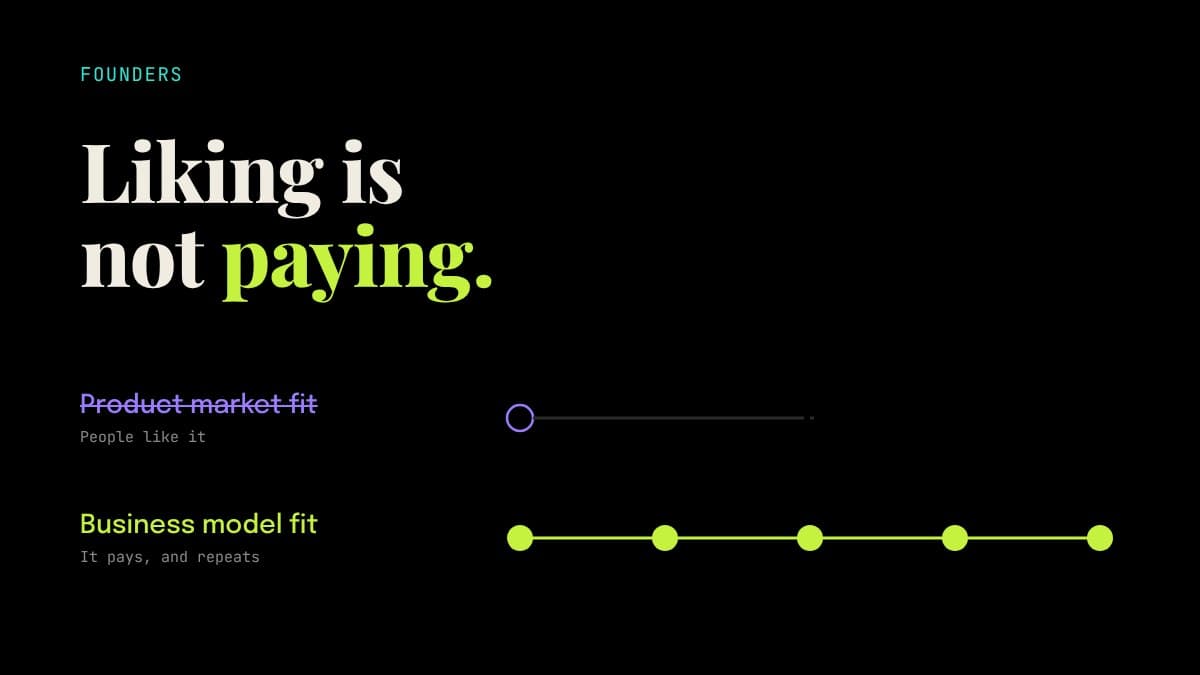
Don't get me wrong, product market fit is interesting. But it gets founders chasing the wrong number. It tells you people like your product. They use it, they come back, they tell their friends. Lovely. But liking is not paying, and using is not a business. If people love your product but never pay you, you're default dead. You just don't know it yet.
The funny thing is, it didn't start out that way. When Marc Andreessen popularised the term in 2007, he said you can always feel product market fit when it's happening: "The customers are buying the product just as fast as you can make it." Buying. Somewhere along the way, founders swapped buying for liking.
Slack had product market fit too
Slack is the story I tell most. Before it was Slack, the team had raised more than $10 million to build an online game called Glitch. It had a small, devoted following. Product market fit, of a kind. But there weren't enough players to sustain a business, so in 2012 Stewart Butterfield decided to shut it down and hand back the roughly $5 million that was left.
His investor at Accel, Andrew Braccia, said no. "If you want to continue to be an entrepreneur and build something, then I'm with you." Good VC.
The something was hiding in plain sight. To build the game, the team had built themselves an internal chat tool. Other teams would pay for it. That became Slack, and in 2021 Salesforce bought it for $27.7 billion. Same team. Same tool. Finally, a business model.
Tesla tells the same story from the other end. In 2006 Elon Musk published the plan: "Build sports car. Use that money to build an affordable car. Use that money to build an even more affordable car." The Roadster proved the technology. It was never the business. Tesla didn't post its first full-year profit until 2020, three years after the Model 3 went into production.
Building is now the easy bit
Earlier this year I wrote that with AI you can go from idea to revenue in 120 days, and that an MVP can launch for a couple of hundred pounds rather than two hundred thousand. Still true. It's also the problem.
My last startup had a team of 15 developers and took three years to build the platform properly. Honestly, I could build the same thing myself now on Claude Code in about four weeks. Seriously.
So when anyone can build a decent product in a weekend, product market fit gets cheap. Put a free AI tool in front of enough people and some of them will love it. Sign-ups, usage, a waitlist, lovely feedback. None of it tells you whether there's a business.
I meet founders every week who show me the love. "We have five proofs of concept. We're not charging for them yet, but people really like it. You should invest." And I'm like, if you're not generating revenue, how are you going to make me a return?
Find the recipe
Anyone watch the Great British Bake Off? The early stage of a startup is the experimentation tent. Couscous, strawberries and chickpeas in one cake. Will it work? Usually it implodes. Or they bake something delicious, then can't make it again.
Then you find the recipe. Often somewhere you weren't expecting. And you can make it again, not for one customer, but for another, and another, and another.
That's business model fit. Proof you have a sustainable business. You know how you make money, and you can do it again and again.
I learnt this the hard way
Last October I posted that I hated my business model. I loved the problem ScaleTrain was solving, the crazy cost of train travel for UK founders. But it ran on sponsorship, and selling sponsorship felt like asking someone for a favour every single time. Motivii taught me the same lesson years earlier. I loved the problem (I still do), but selling to HR wore me down.
ScaleTrain had people who liked it. Three builds and two business model pivots later, it still hadn't found a model that paid and repeated. So in February I stopped it.
Not all good ideas make good businesses.
Default alive, or default dead
Don't just listen to me. Paul Graham, who co-founded Y Combinator, says that when he talks to a startup that's been going for more than eight or nine months, the first thing he wants to know is almost always the same: "Assuming their expenses remain constant and their revenue growth is what it has been over the last several months, do they make it to profitability on the money they have left?" Yes, and you're default alive. No, and you're default dead.
Business model fit makes you default alive. Product market fit on its own usually leaves you default dead, raising again and again to fund people who like you but don't pay.
And default dead is how most startups actually die. CB Insights studied 431 venture-backed startups that shut down since 2023. 70% of them ran out of capital.
How I test for it
On the Global Entrepreneur Programme I meet founders from Lagos to Istanbul to San Francisco who want to scale through the UK. The first test is a feeling, my own pattern recognition after 25 years of building startups. Then we talk numbers, and I never look at just one.
- Revenue, and how long it's been there. $10,000 a month for three months is a very different company from $10,000 a month for five years.
- Revenue next to market share. $20,000 with 80% of your home market is a nice business that needs a new market. $20,000 with 0.2% means the opportunity is still at home.
- Cash. Consistently making $50,000 a month with more than that in the bank? Interesting. $100,000 this month, $5,000 the month before and nothing in the bank? That changes things.
- Focus. One problem, one solution, one customer type, one business model. I met a founder recently who'd made $30,000 across nine different revenue streams. Nine bits of easy money, and not one with real potential.
- Grants are not revenue. A founder in Cairo told me they were making $1.2 million. $100,000 came from their app. The rest was a project for a Dutch government development agency. In other words, a grant. Great money. Not commercial proof.
Don't leave home too early
People across North Africa were surprised by this. They expected a British government event to say come to the UK, come to the UK, come to the UK. I said the opposite. Come when you're ready.
You know your country, your customers and your challenges. If the model doesn't work at home, why would it work for the first time somewhere new and more expensive? The opportunity in the UK is huge. But you need to arrive fit and strong enough to take it.
The KPI that matters
AI has made building cheap. It hasn't made customers cheap.
So stop measuring love. Start measuring revenue that repeats.
That's business model fit: proof you have a sustainable business. Right now it's the best KPI a founder has.
Thinking about scaling through the UK? GoUK is my free tool for founders to check whether they're ready, across market access, talent, IP and capital. And if you want to work on business model fit itself, that's what my founder coaching is for.